There are two forests. The day forest and the night forest. To experience this you must walk in the forest, with not more than a single companion. A companion who knows how to handle himself in the forest, who understands the forest and who is familiar with it. Not a companion that needs looking after. I insist that the only way to experience the forest, especially the forest of the night, is by walking in it. If you drive, even in an open vehicle, and slowly, you will never get a sense of what I mean. Walking is the best way because it is at a pace that enables you to savor the aromas and identify them. Slow and quiet enough to hear small sounds, rustles, knocks on wood, the sudden scuffle and last squeak of the vole or mouse in the talons of the owl. Walking puts you on the same level as the inhabitants of the forest for whom it is home. Driving isolates you, you are an outsider in a machine, you are shielded from the forest, protected from its threats, not one with its rhythm and an alien, to be watched with suspicion, and hidden from until you disappear. But the walking man, especially the one who walks without a torch, at home in the forest, seeing with moonlight, passing silently through is one of the dwellers of the forest. He is still watched because all men must be watched. But he is himself vulnerable and not necessarily a cause for alarm. When you walk, the forest treats you differently.
The forest is a living entity which is comprised of many components. Like our bodies are comprised of many parts, each fulfilling a need and each essential to the whole, no matter how small and insignificant it may seem. So also in the forest, everything has a role, a part to play to support the whole ecosystem. Some things which seem to be dead and useless are often the most dynamic and beneficial. A dead tree for example. When a tree falls, it is not the end but the beginning of support, protection, shelter from the elements and predators, food for plants, fungi, and the earth itself for generations of creatures who inhabit the forest. The death of a tree, and I mean by natural causes, not felling by humans, when it is left where it fell, to gradually change form, to give life to others, is an event that those who live in the forest celebrate. When you walk in the forest you learn to appreciate that what you are seeing, trees, grass, vines and creepers, flowing streams, muddy puddles, dry leaves carpeting the forest floor, smoldering or cold ashes of a forest fire, the new growth that springs forth from the grey ashes, the drone of cicadas, the Brainfever – brainfever call of the Common Hawk-cuckoo (Hierococcyx varius), repetitive enough to drive you crazy, the knock-on-the-pan sound of the Crimson-breasted Barbet (Coppersmith Barbet), and many more are all related. Each one is part of the story and has its own tale to tell. You can see this only when you walk – not to cover ground, but to listen, observe (not only watch), feel, smell and where appropriate, touch. Walking gives you the leisure to stop and listen and observe and keeps you at a level where you are close to the earth.
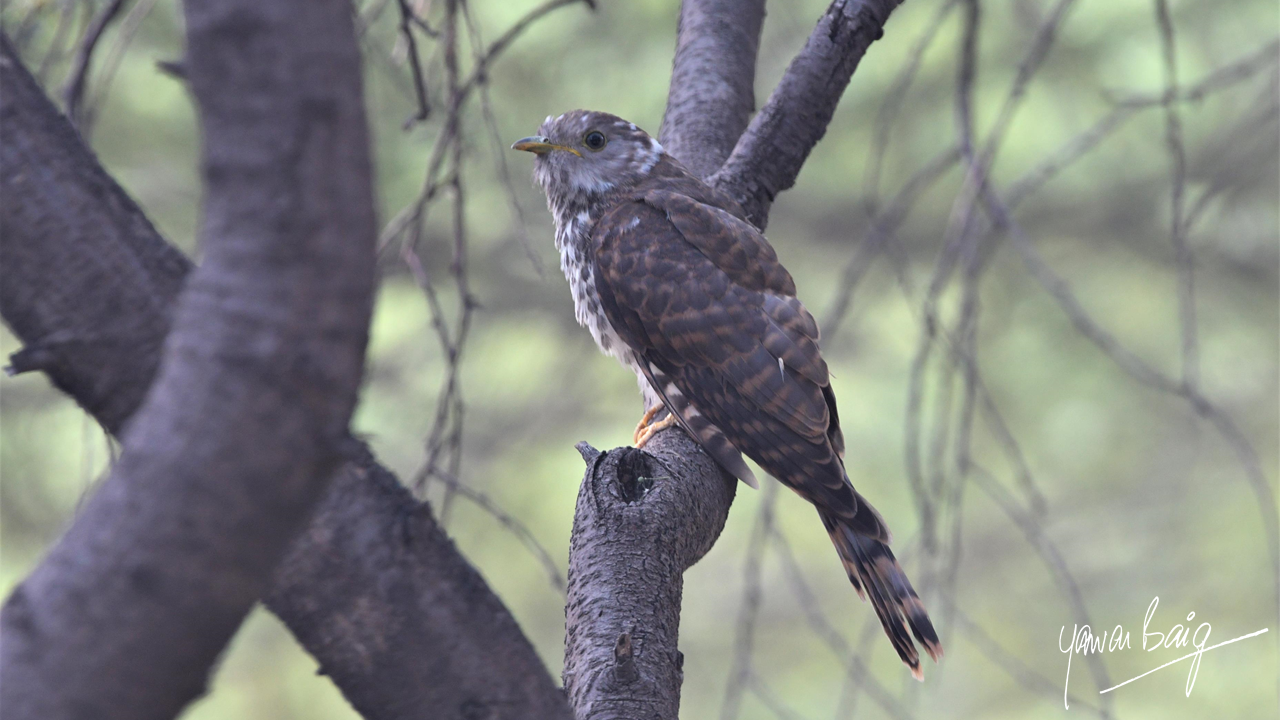
Common Hawk-cuckoo (Hierococcyx varius)
The forest is a living being. It is not simply a collection of trees with some animals, birds, reptiles, and insects thrown in. It is one living creature comprised of all those who live in it. Some walk, some crawl, some fly, some talk to each other below the earth, some support each other high above the ground. Some find shelter and protection in it. Others use the same hiding places to ambush their prey. The forest talks to those who understand its language and gives its message, sometimes of tranquility, at other times, warning of lurking danger. But you must understand its language to know what it says.
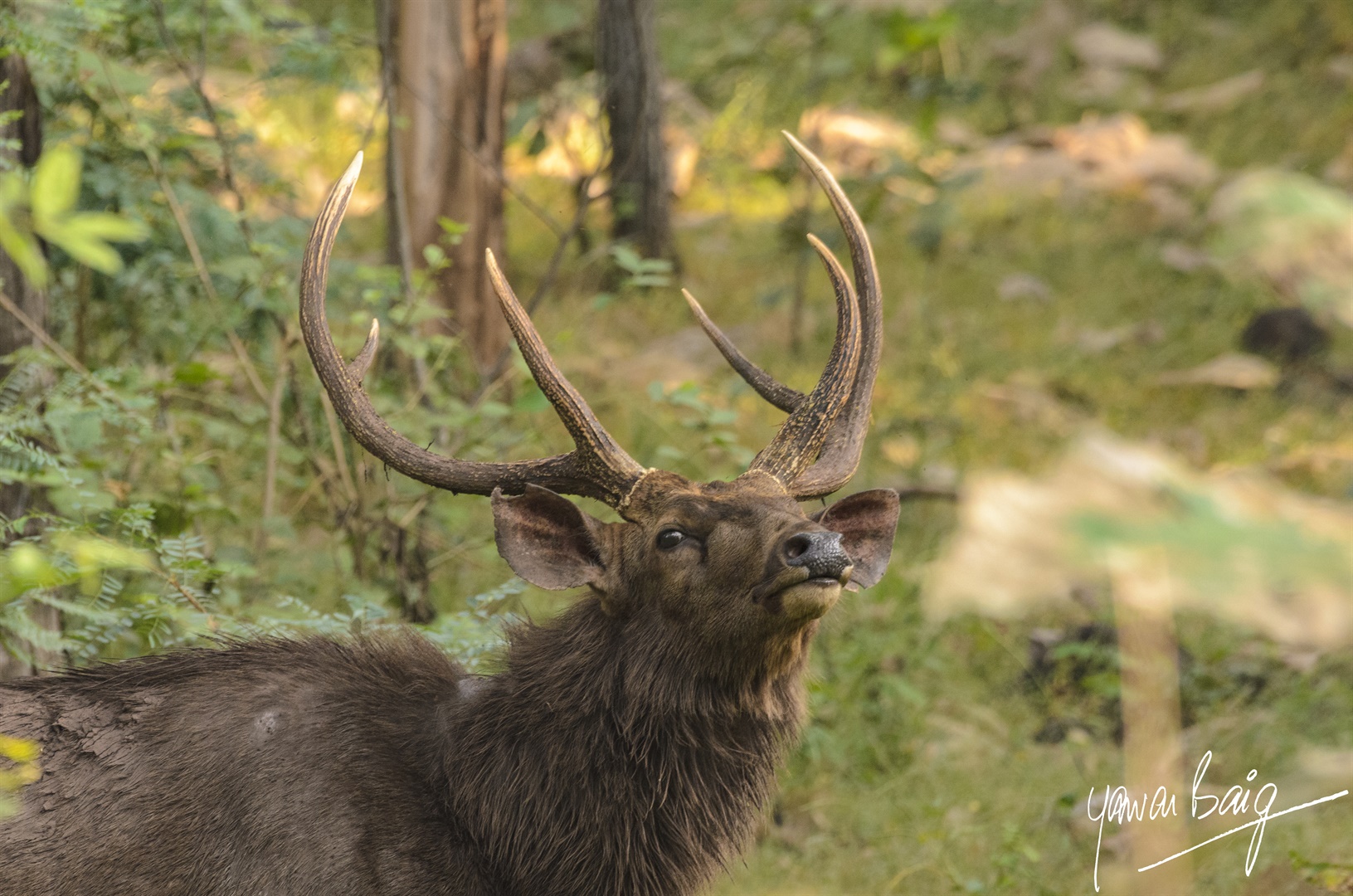
This night Shivaiyya and I are on our way to a mud-roll to see if we can perhaps bag a Sambar (Rusa unicolor). This mud-roll is at the bottom of the high, almost-mountain that you can see from Uncle Rama’s cottage, looking deceptively near but is about five miles away. That is not such a long distance to traverse in daylight but at night it takes a bit of time. But we are in no hurry to get there. Sambar don’t roll until very late at night, when the jungle is as still as it ever is. As I mentioned, the rolling spot we were going to was at the foot of the almost-mountain where there is a depression in the ground and runoff water collects. Eventually in the full heat of summer, it will dry but just now, there is water in it which mixed with mud that gets churned by Wild Boar and Sambar, is like a thick rich, brown soup. Sambar browse all night and then just before dawn they go to their favorite rolling spot, a wide pool full of slush. They roll in it until they are covered in liquid mud which later dries to form a coat impermeable to flies and biting insects which are the bane of their lives. A good roll ensures that they would be able to rest up during the day peacefully. Sambar are active at and after dusk into the night and spend most of the day resting in shady spots. The only danger with rolling is that tigers also knew about this habit of the Sambar. So, rolling spots are a favorite ambush spot for the tiger. A Sambar rolling in the mud is almost a sure meal for the tiger because it is impossible for the Sambar to rise from a prone position and run before the tiger closes on him. So, Sambar are extremely cautious when they go to roll and spend far more time casing the joint, than in rolling. The roll is really a quick one, very like a horse rolling in the dust (for the same reason) and then he is up, all senses at high alert, trying to see if he can do another roll or must run for it.
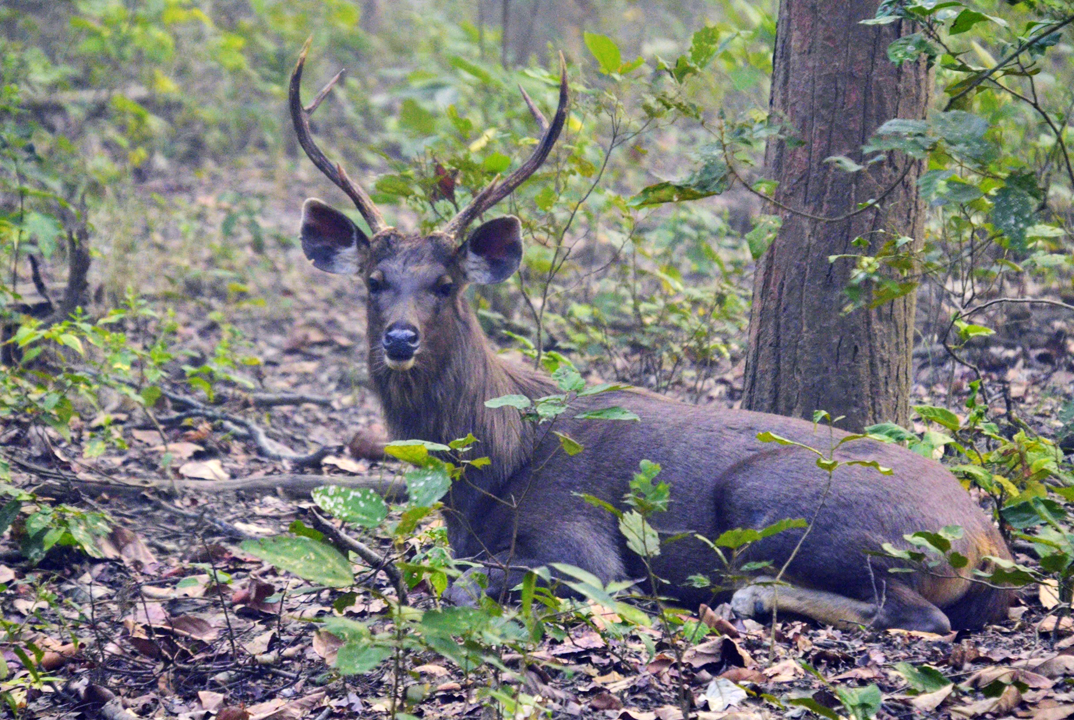
Sambar (Rusa unicolor)
The footpaths you walk on are witnesses to history themselves. They were formed by the footsteps of countless generations of animals going to the river to drink. They follow the easiest contour of the land. Forest people use these paths as they are the most convenient to walk on. Villagers drive their cattle on the same paths as they take them to graze in forest glades. And you walk on these paths as you explore the forest. It is possible, in these forests of the Sahyadri Hills where I am, to strike out on your own away from a path. The lay of the land, the semideciduous nature of trees, the relative openness of terrain, all make walking easy. Unlike the rainforests of the Western Ghats where I lived for ten years or on the other side of the world, in Guyana, South America, where I lived for five years. There the forest is so thick that it is impossible to strike out from the path without a machete to clear the way. But not here.
I call the paths a witness to history because if you walk carefully with your eyes on the ground ahead of you and if you know what to look for, the path will tell you who went ahead, in what direction, and how long ago. It will tell you if the one who went ahead was in a hurry or not. Depending on the species, if it was male or female. All this is essential information for you as you walk along because some of it is interesting to know and helps you to anticipate who you are likely to meet. Some of it may potentially be lifesaving because it will help you to avoid meeting those who may take an unnecessary interest in you.
At night most if not all these details are hidden in the darkness and the path becomes an ever-changing dappled carpet with moonlight filtering through the leaves and shadows dancing to tune of the breeze. When you walk without shining a torch, your eyes get used to the low light and you can see perfectly well. But sometimes things are deceptive. A rock in the middle of the path will suddenly fly away, shooting up from its place like a rocket. That is when you realize that it was not a rock but a Nightjar, (Caprimulgus asiaticus) doing what Nightjars do best; sit motionless on forest paths, waiting for the unwary insect to fly past. The Nightjar then shoots up from its seat, grabs the insect and returns, all in one single fluid curve. They take position as soon as night falls and leave when dawn arrives and go to their day perches on tree branches, hollows or high rocks in shade, where they have shelter from the sun and predators. Their camouflage is so good that they look like a bump on the branch. At night when they are in their hunting positions, they make the typical tut-tut-tut-tutrrrrrrrrr call. It almost sounds mechanical as if made by a machine. You can listen to it here https://ebird.org/species/indnig1
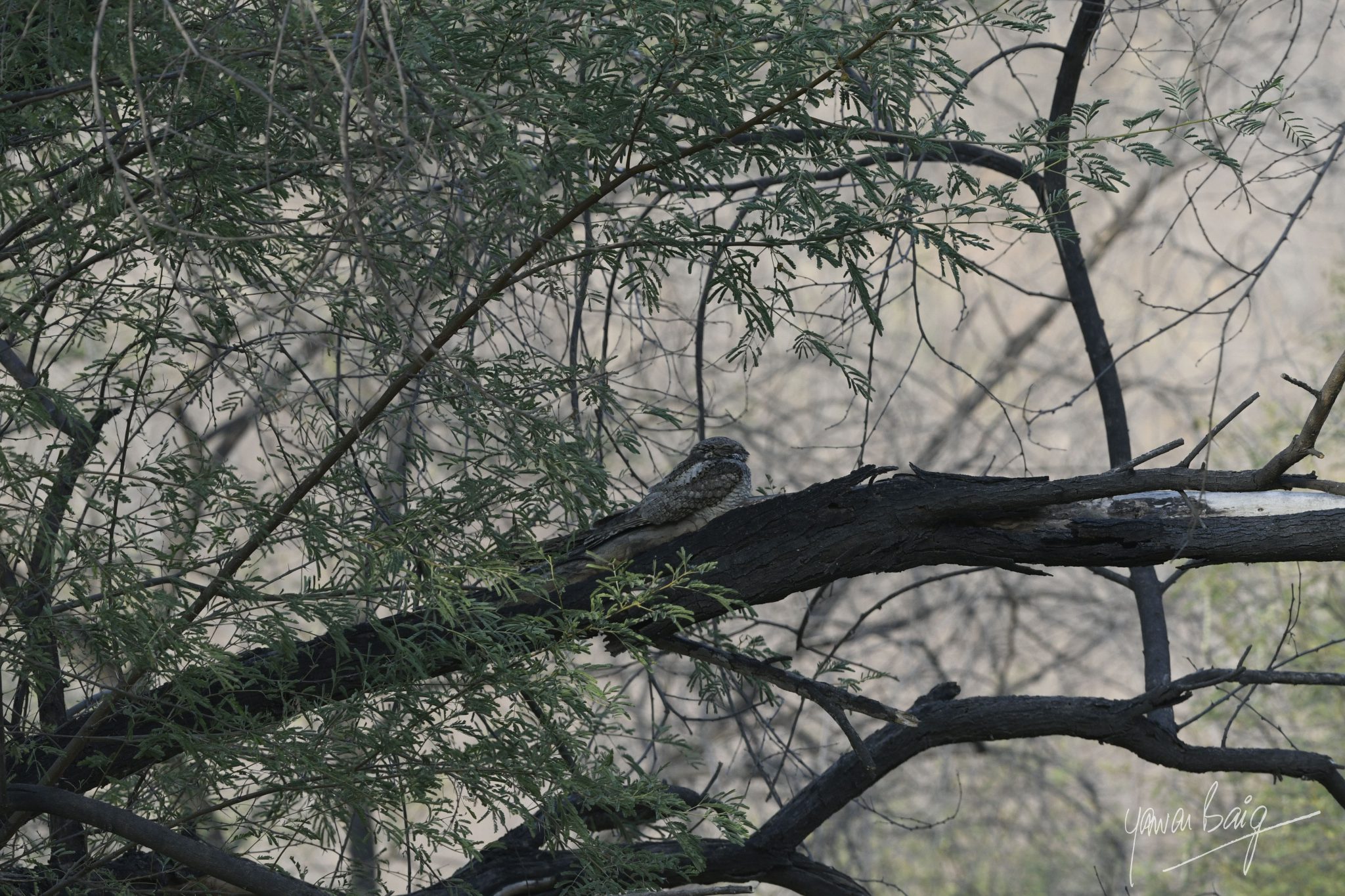
Nightjar (Caprimulgus asiaticus) on its daytime perch
Sunset and the coming of night is an experience to be savored in the forest. Needless to say, it is different in different lands. Here in the Sahayadri Hills of Telangana, India, in the Tropics night falls quickly. Daytime calls of birds like the Common Hawk-cuckoo and Crimson-breasted Barbet, cease. It is not as if a switch was turned off. You just notice a change in the melody of the forest in which they are missing. Insect sounds increase. Where there are cicadas, there is no hope of hearing anything else but otherwise you hear a tune that sounds alien, high pitched yet not too loud, constant as if the singer doesn’t need to draw breath. In this case, it doesn’t. Insects are the real aliens on the planet. Or maybe it is more accurate to say that we are the aliens on their planet. They are far more numerous and long-lived than we will ever be and will still be here when we have succeeded in wiping ourselves off the face of the planet, to say, “Good riddance to bad rubbish.” As night falls, they start their songs, each one different from the other but blending in to create a melody that is the background song of the sunset.
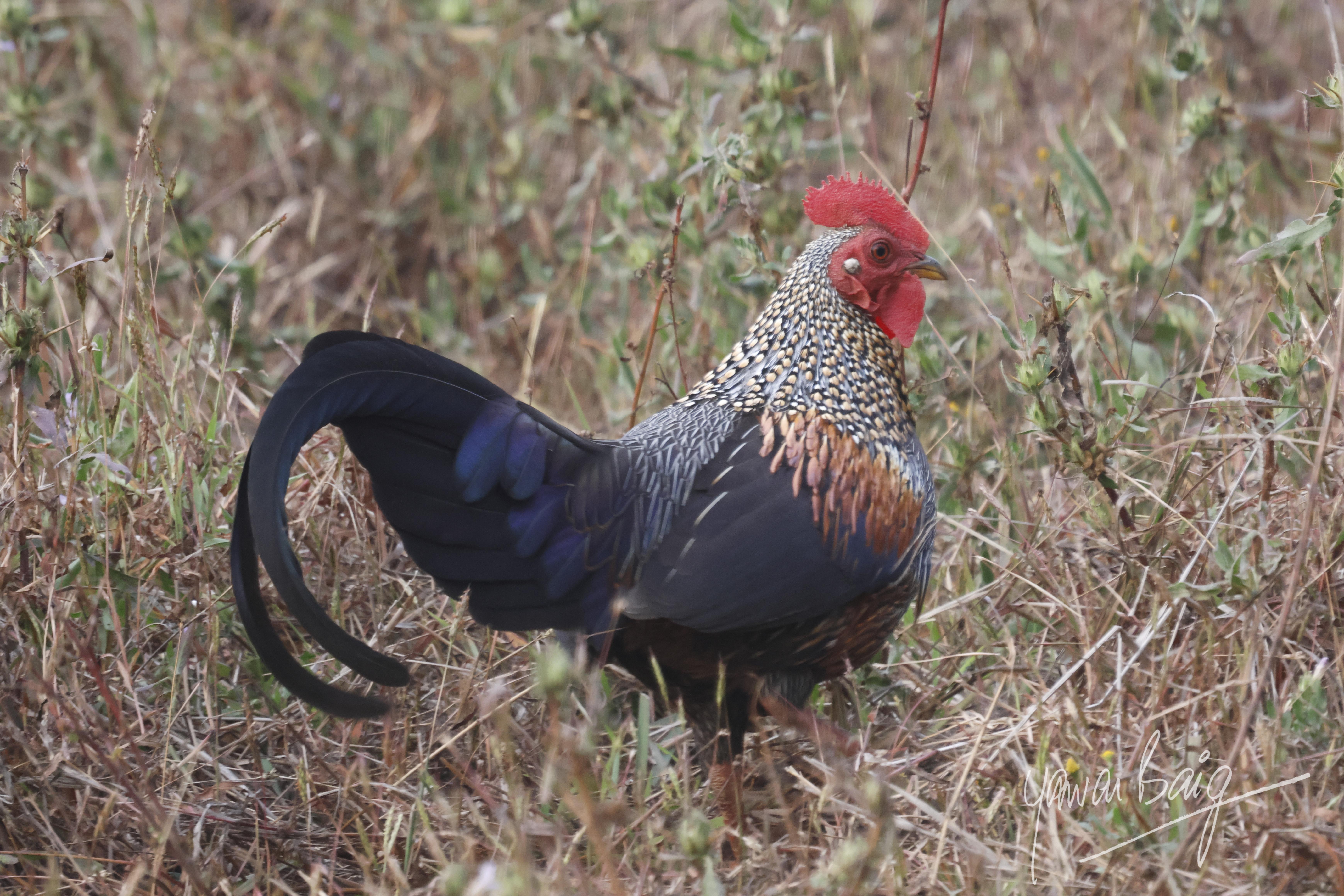
Grey Junglefowl (Gallus sonneratii)
Grey Junglefowl start calling as they prepare to fly up to their roosts. Only the roosters call – Kuk-koo-kuk-kuk – you can listen to it here. https://bit.ly/42z9198 The marvel that is YouTube and all those who post these wonderful videos on it. However, let me assure you that the experience of listening to this call, sitting quietly in a forest, watching the sun set is not something that any YouTube video can give you. So, go out there and listen before it is too late. Next are peafowl. The most magnificent of birds with the loudest of calls, a mewing scream that ends on a question mark. https://bit.ly/4uRo1eE Like all birds, the peacock doesn’t only have one call. So, when someone says, ‘The call of this or that bird’, what they mean is the sound that bird makes in the normal course. But there are other calls, calling to mate, threatening an intruder in its territory, alarm call warning of a predator on the move, call while flying up to roost or flying down from it in the morning, calling its young to eat, and so on. Communication is not simple, for us or them. Peafowl call as they prepare to fly up to their roosts and then call as they fly heavily to the topmost branch of a forest where they sit, totally exposed to the elements. While that seems to be an extremely uncomfortable place to be in, it is also the safest because nothing can hide while it sneaks up to you. Peafowl make great lookouts. Peafowl are primarily terrestrial and fly only to escape predators or to roost. Understandable, since an adult male with a full train (tail feathers) is a very impressive but heavy bird. As you listen to the Junglefowl and Peafowl, night falls and the sky darkens. If you are where you can see the horizon then be prepared for some of the most spectacular oranges and reds that you can imagine, different each day, to show you the infinite variety on the palette of the Artist. As it gets dark, with the accompaniment of the insect song, you start to hear the tut-tutrrrrrrrrr call of the Nightjar. You start to relax and feel safe and tell yourself that all is right with the world.
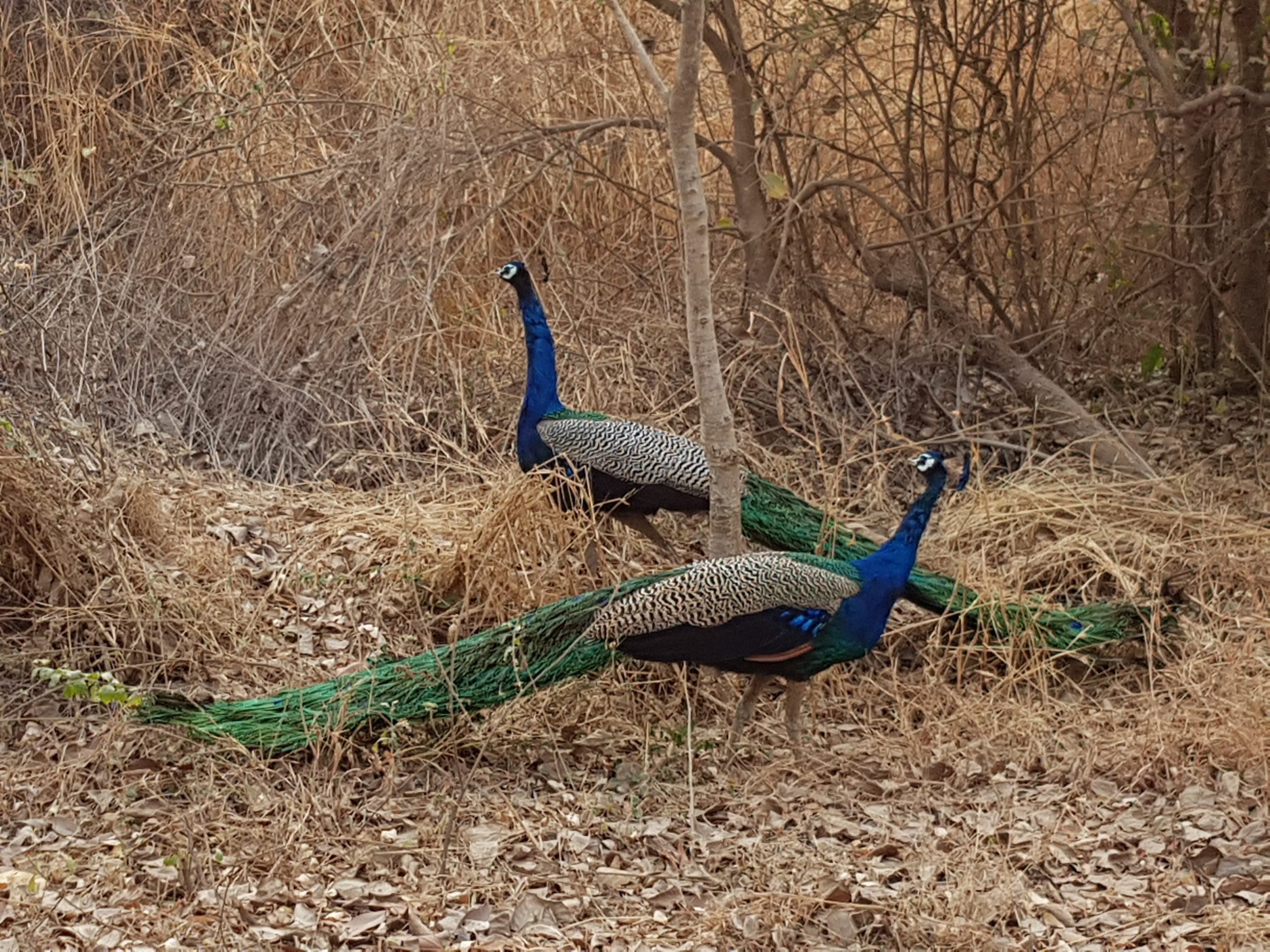
Peacocks (Pavo cristatus)
Never forget that ‘right’ has a meaning that differs from creature to creature. What is right for the predator is not right for the prey. Prey animals, Barking deer, Chital, Sambar, Nilgai, Langur and others, have much poorer night vision compared to tigers, leopards, owls and other nocturnal predators. Predator behavior changes when it gets dark. The lethargic highly tolerant tiger that ignored a million gawking tourists in the day as it lay semicomatose half submerged in a waterhole, becomes a very different animal when it gets dark. Eyes bright and shining almost with an inner light, muscles rippling, all senses alert testing the breeze for the smell of prey, rested and ready to hunt, it is far more alert and aggressive than the picture of tranquility you saw in the day. There is nothing tranquil about a tiger on the prowl. It is focused and deadly. That is true of the leopard also, except that for its prey, death wears a different coat. That is why the Langur sentinel tends to panic and sounds the alarm, sometimes at shadows made by branches moving in the breeze. He can’t afford to take a chance. Better to be wrong than to be dead.
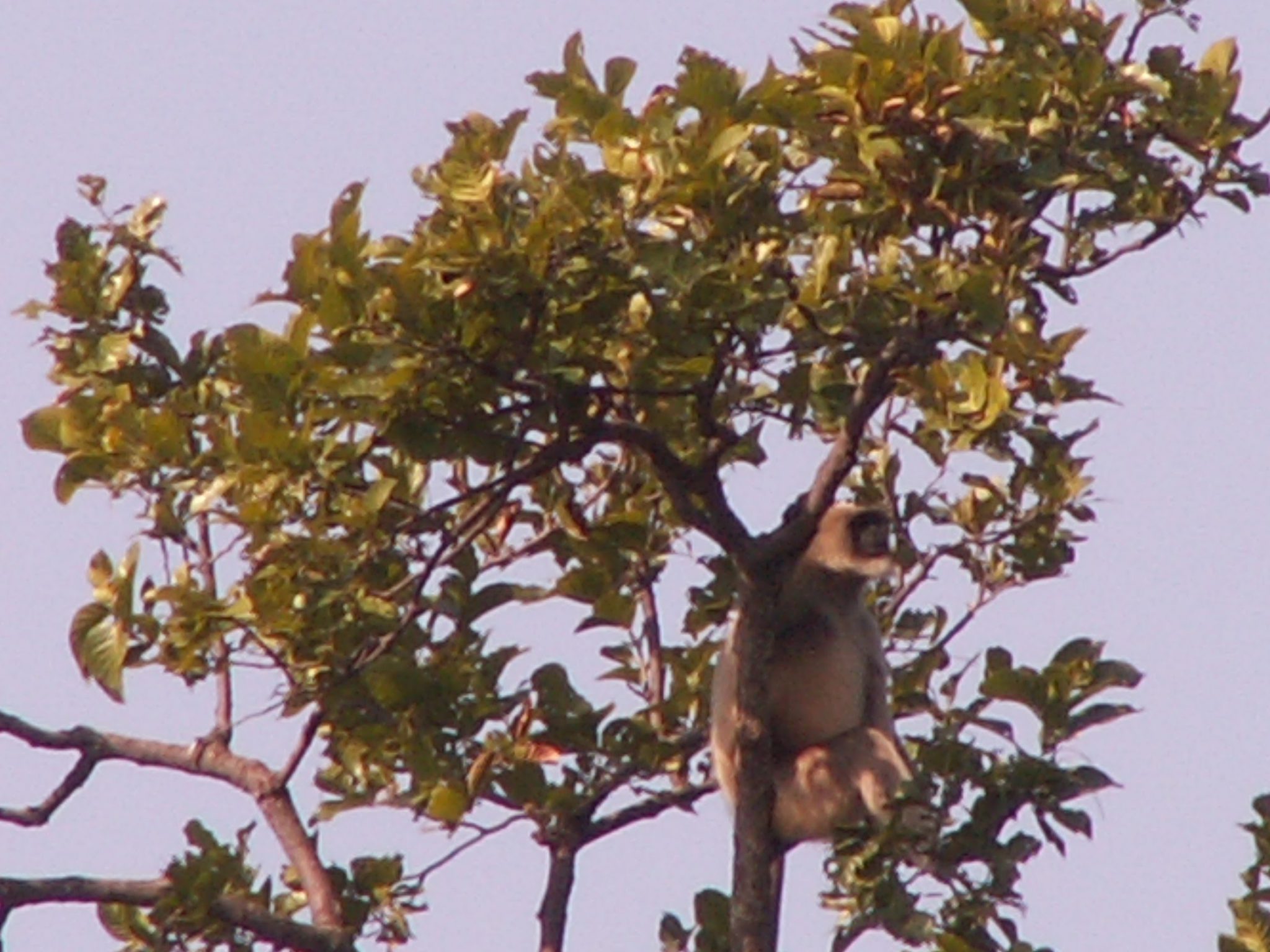
Langur (Semnopithecus entellus) - the sentinel
Langur rest in the canopy and have a protocol where one is always on duty as a sentinel. Others take turns with him so that he can feed or rest at night, but one is always awake and alert. All other forest denizens rely on the Langur sentinel to alert them in time to get away. Leopards hunt Langur in the trees in the night, running along the branches and leaping from one to the other, as if on a road, so Langur need to be alert. On the ground, Barking deer are the most likely to sound the alarm, at almost anything and sometimes at things they imagine as they go about their business. https://bit.ly/493f2OR Chital call their shrill bark, when they see a predator, leopard or tiger. If you can see the Chital sounding the alarm, it looks at the place where it thinks or knows the tiger is hiding, like a Pointer pointing to grouse. It raises a foreleg and stamps as it calls. And keeps calling until it is sure that the threat has abated. https://bit.ly/4eHxr7B But the most reliable alarm call is that of the Sambar. A deep Dhank-dhank and you know that the King is on the move. https://bit.ly/42BDinH Sambar are the third largest deer species in the world after Moose and Elk. An adult male (stag) stands more than 5 feet at the shoulder and weighs around 350 kilograms. Some large males can go up to 550 kilograms. On its head it carries a huge rack of antlers with 3 tines (points) on either side. It is big and armed and so is not easily alarmed. But a tiger is a tiger and demands respect which is faithfully rendered. When the Sambar calls, Chital take it up and Langur echo it and for a time, the forest is totally alive and awake. It is an incredible experience to be there and absorb the atmosphere, listen to the calls, understanding each one, pinpointing the direction of the call which will tell you which way the tiger is moving. Sambar will keep belling as long as they see the tiger, so you can track the tiger as he moves. It is critical for you to be able to identify animal calls and understand what they are saying, because sometimes it can spell the difference between life and death for you. Nobody can afford to relax or lose their awareness in the forest of the night. Neither in the day, but especially at night.
Given all this and the fact that human night vision, no matter how good, is not a patch on that of any herbivore, it is wise not to wander around in the dark in the forest. So, Shivaiyya and I are in the spot where we will spend the rest of the night. This is a rough ‘blind’, a few meters away from the mud bath, just inside the tree line on the flat ground at the foot of the mountain. We had dragged a couple of dead logs and stacked them on top of each other in front of a big Ber bush right in the center, totally impregnable and full of vicious thorns before which we sat. A cover for us from anything that may approach us from behind. The logs were there to give us a waist-high parapet to sit behind and to use as a rest for the barrel of the rifle when I wanted to shoot. Our outline is broken by the trees and undergrowth behind and on either side of us. In the forest for roles to flip from hunter to hunted is very easy and quick. The result of being unwary is permanent and irreversible. Humans are not normal prey for any predator. But there is always an odd individual who doesn’t know the ‘rules’ or doesn’t care. So, anyone who is not interested in becoming dinner, should take care of all eventualities, no matter how remote.
As the night passes, the alarm calls end. Sometimes you know why because you would have heard the last, despairing scream of the Chital as he goes down. At other times, you know what happened from the silence. When the tiger stops moving, it is because he has killed. He then drags it into a nearby thicket to hide it from scavengers, eats his fill and hides the rest. Leopards usually take their kill up a tree and wedge it into a crotch or split branch and eat from it until it is exhausted. Usually, the only ones who share that meal are Tree Pies and Crows. Leopards hide their kill in the canopy where it is not visible to vultures and high enough to be out of reach of hyenas, jackals, foxes and other smaller carnivores.
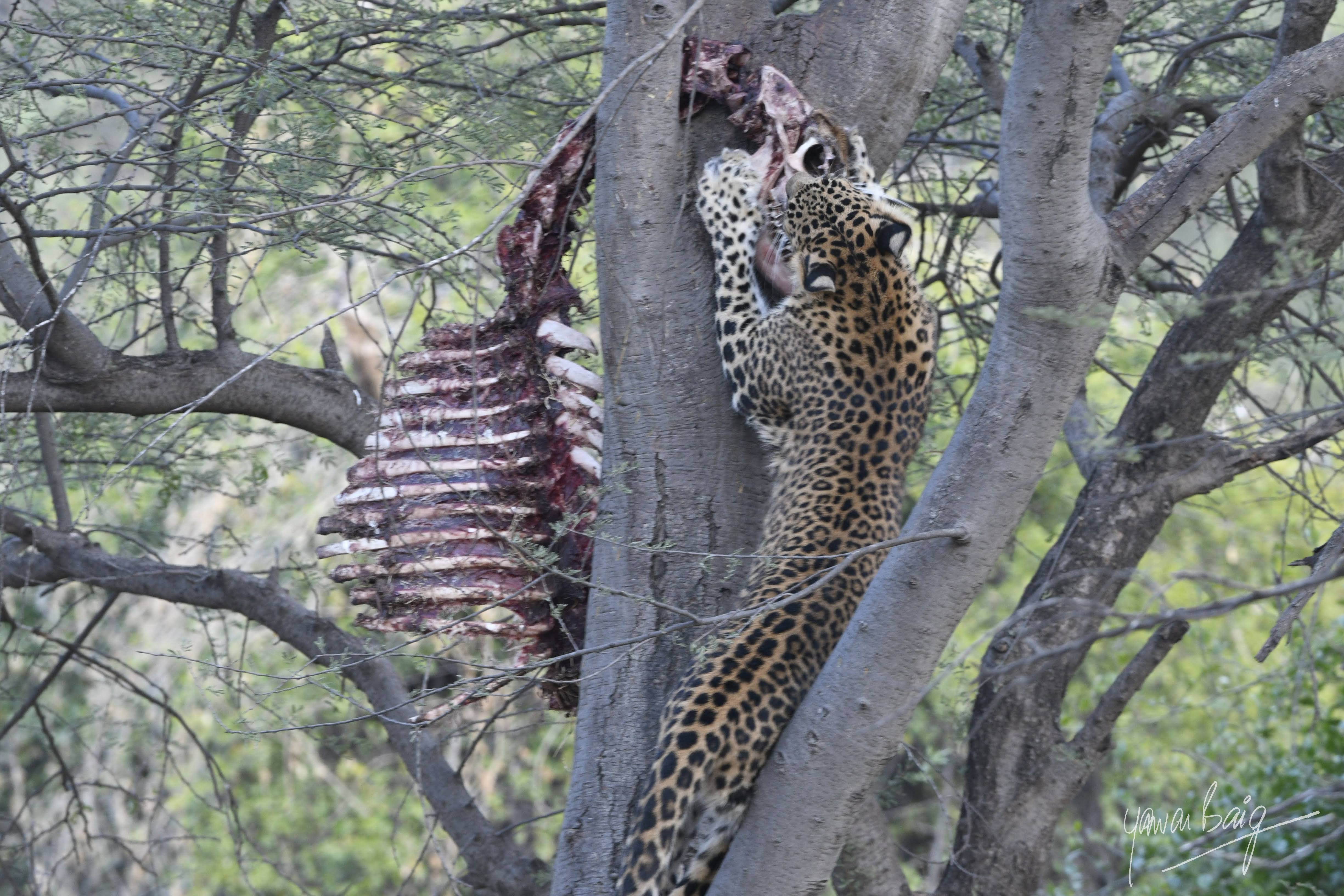
Leopard eating from a Nilgai or Bluebull - (Boselaphus tragocamelus) kill
It is late December and the night is bitterly cold. But we can’t even imagine lighting a fire, because that would drive every animal away. So, the cold must be borne in silence. The moon traverses its path and the direction of light changes subtly. I am as stiff as a board sitting still in the cold and dying to stand up and stretch but that is out of the question. Then suddenly a small stone rolls down the hill. Shivaiyya touches my shoulder. All my tiredness vanishes. My eyes shine with anticipation. It looks like our night vigil will not be in vain after all. He is coming.
My every sense is alert. I smell him before I see him because his camouflage is so good, but it doesn’t hide the rank smell of the Sambar stag. He is completely invisible against the side of the mountain that he is coming down. Mercifully the breeze is blowing down the mountain in our faces, so he can’t smell us. Our camouflage is also good with our body outline broken by the bush behind us and so he can’t see us. As he threads his way down the rocky slope, one cautious step at a time, looking all around, his keen nose sampling the breeze checking for threats, he kicked a small rock which rolled down a few feet and clicked on another rock. That is what alerted me and Shivaiyya. Such small things spell the difference between life and death in the forest.
Nothing in the forest can be hurried. It happens in its own good time. All that you can do is to wait and enjoy the process. Step by cautious step, the Sambar stag comes down the hill until he is standing in the mud. The reason he came. Shivaiyya and I sit absolutely still. I need to get my gun in position but to try to do it when the Sambar is scanning for threats would send him off in a flash and all our hard work of sitting in the freezing cold of the night would be lost. We watch him. I try to drink in the experience so that I could recall it as vividly as I saw it then.
The Sambar was sure that all was well. He knelt as a horse does when it rolls in the sand. Then on his side, over on his back and halfway up. Then on his other side and back and a scramble up to stand tall again. This time completely covered in a coat of brown mud. He snorted. This was the time for me to pull the trigger. Everything was ready. As he was rolling, I had my 7.62 rifle up and ready, looking down the barrel with the sight centered on a spot just behind his shoulder and above his elbow. That would be a clean heart shot and the animal would drop where it stood. The Sambar stood there. He appeared to consider doing a second roll. But decided against it. I could see that he was about to start walking away. Sambar don’t like to spend too much time at these mud baths because they are most vulnerable there. I could imagine Shivaiyya on tenterhooks wondering what was wrong with me. Why wasn’t I shooting?
I did not shoot because I discovered that I could not shoot. That’s it. I just watched the Sambar stand there for a few seconds that felt much longer. Then he walked away, past our blind, into the forest behind us. As we sat back, Shivaiyya didn’t say a word. He understood perfectly what had happened and he was happy. I was a young boy in his care, and he liked the lessons that I was learning. That beauty is in life. Not in death.
He lit a beedi and then a small fire. There was no need to freeze anymore, and we could afford to warm ourselves. He poured out the sweet tea that Kishta the cook had given us and we sat in companionable silence, dozing sometimes until dawn and it was safe and easier to get home.
Comments (0)
Please log in or sign up to leave a comment
Loading comments...