The Challenge of Teaching in an AI World
In a world where we seem to be in a state of constant churn and flux, it is increasingly critical that we acquire right knowledge and live by that through whatever turmoil may happen in society or our lives. This requires an attitude of steadfastness. To be what we were created to be fully, passionately and with commitment. Darkness has no existence of its own. It is the name given to the absence of light. A lamp doesn’t do anything to the room to light it up. It lights itself up. And darkness disappears. Because it is the nature of darkness to disappear.
Attitude is at the root of everything. Attitude decides whether we will succeed or fail. Whether when in difficulty, even that which seems to be life threatening, attitude decides if we will survive or perish. Attitude decides if when hit by life we stay down or get up. And how many times we get up. And what the result will be of getting up every time we fall. Attitude, not wealth, dictates happiness. If you don’t believe me, watch village children leaping into pools of rainwater after the first rains. Do they look happy? Then go and watch your children, who will most likely be complaining about the rain. And ask yourself, “Who has more wealth?” I know that is a dumb question, but then to decide to remain dumb is an attitude issue. To decide to remain blind, even though we have eyes, is an attitude issue. To witness a crime in progress and to decide to make a video to post on Instagram, instead of taking action to prevent the crime or to help the victim, is a matter of attitude. Satisfaction, gratitude, ambition, courage, compassion are all attitudes. So also, are their opposites. And each one has an impact on our life. Attitude comes before all situations and circumstances and decides how they will affect us. To create an affect, we must address its cause. Attitude is the cause.
In my view the best thing about attitude is that it is entirely in our control. Nobody can give it to us or take it from us or change it for us or do anything at all with our attitude. We, and only we, can have whatever attitude we want to. So only we can decide if we want to be sad, glad, bad, mad or whatever. That means that until we want to change it, nobody can help us and if we want to change it, nobody can stop us. That is power. My question to you therefore is, why do you teach? You don’t need to answer me, but it is a question which I submit, that you must introspect deeply upon and answer for yourself. Because it is the doorway to the future of teaching in the AI world. The challenge in the AI world is not that of technology but of attitude.
There are two aspects of AI which we must consider. What it can do and what will happen to the world as a result of that. You will notice that all the proponents of AI talk exclusively about the first but say nothing about the second. For example they tell you how fast it gets you results and how thorough its answer is, to every question you ask. But they don’t talk about what water guzzling data centers will do to the water table and the inevitable water scarcity for local communities. It is not for nothing that there have been major agitations and complete refusal by American and European communities to allow data centers near them. No money to guess what that means for Asian and African countries. The second aspect of AI which I will encourage you to research for yourself is, where the focus and deployment of AI, is. Is it to make manufacturing cheaper and maximize profits or alleviate suffering and raise the quality of everyone’s life? The focus of AI, not surprisingly, is on what’s best for its owners. Not for you and me. That’s why as we stand here today, the maximum use of AI is in surveillance and weapons of mass destruction. Who benefits is clear for anyone who wants to see. That is the reality behind all the fog of AI sales spiel.
Let me give you an overview of what AI is and how it is already affecting our lives. 1760 – 1840 was when the Western world changed from being agrarian to becoming an industrial economy. The impact on people was immense, but essentially, it took a farmer away from his plough and bullocks and put him in the seat of a tractor. It took farmers away from their farms and gave them jobs in factories. The Industrial Revolution had less to do with how goods were manufactured and far more with how capital was treated, lifestyles and values were changed, and the engine of colonialism was started which literally changed the map of the world. That was when the first joint stock company in history, the East India Company, came into being which ruled India for more than a century. I will not elaborate on these things today but the point I want to make is that not only did every farmer get a job, but soon, every farmer’s wife also got a job because the intake of factories was insatiable. That is the root of the change in womens’ fashion but that is also another story for another day. Today I want you to simply remember that every farmer got a job. What changed was how he worked. But he had work.
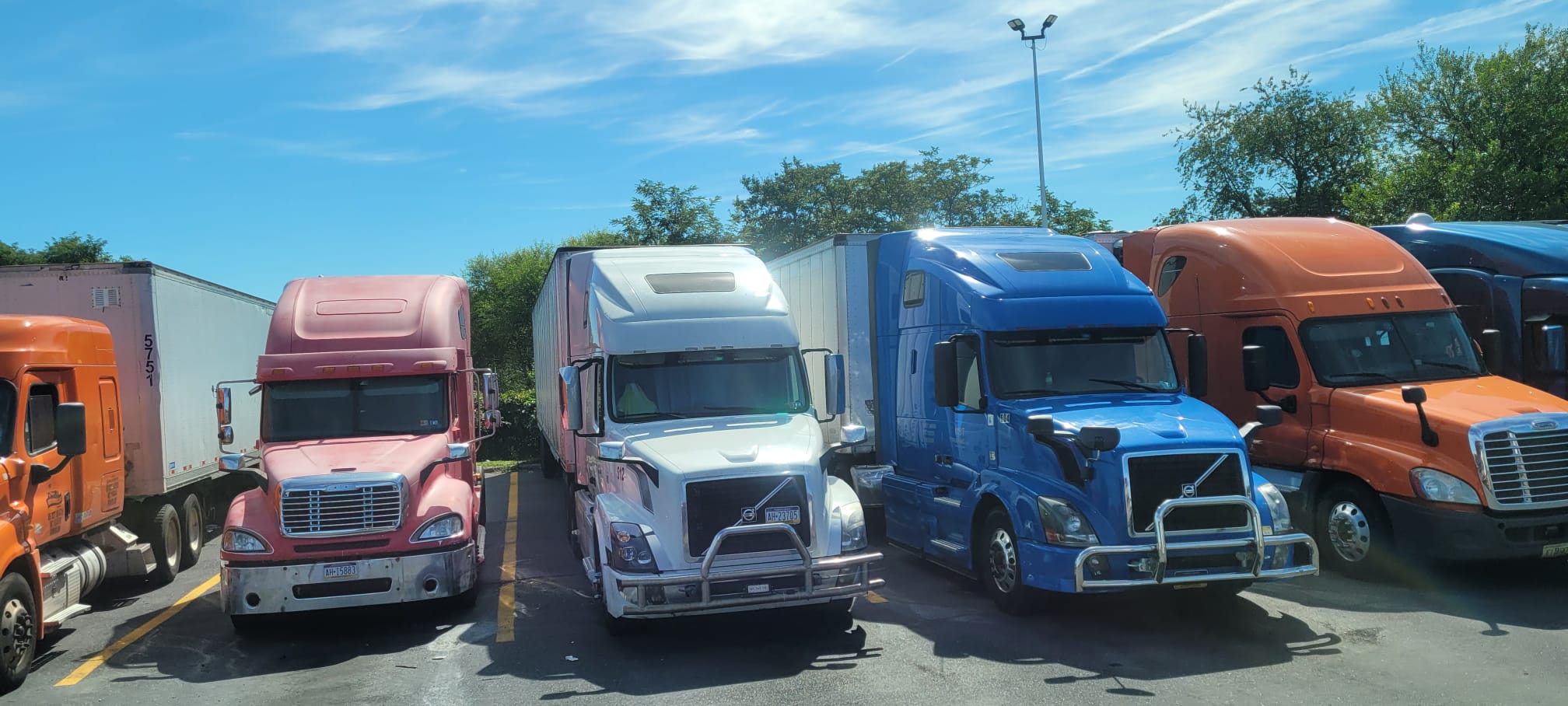
Pan now to truck drivers in the US. There are, according to the American Trucking Associations, 3.5 million truck drivers who drive what they call ‘rigs’. Semi-articulated truck-trailers with a massive engine with a cab on it, pulling one or two container trailers behind it. Altogether it has 18 wheels. Variations can have 24 or even 36 wheels. If you get into the cab, you may think that you are in an airplane cockpit, seeing the mass of gauges and lights you will be faced with. The cab has a comfortable cabin inside it with a refrigerator, TV screen, satellite dish, electric hotplate, twin bunk beds, and reading lights. There is even a small toilet.
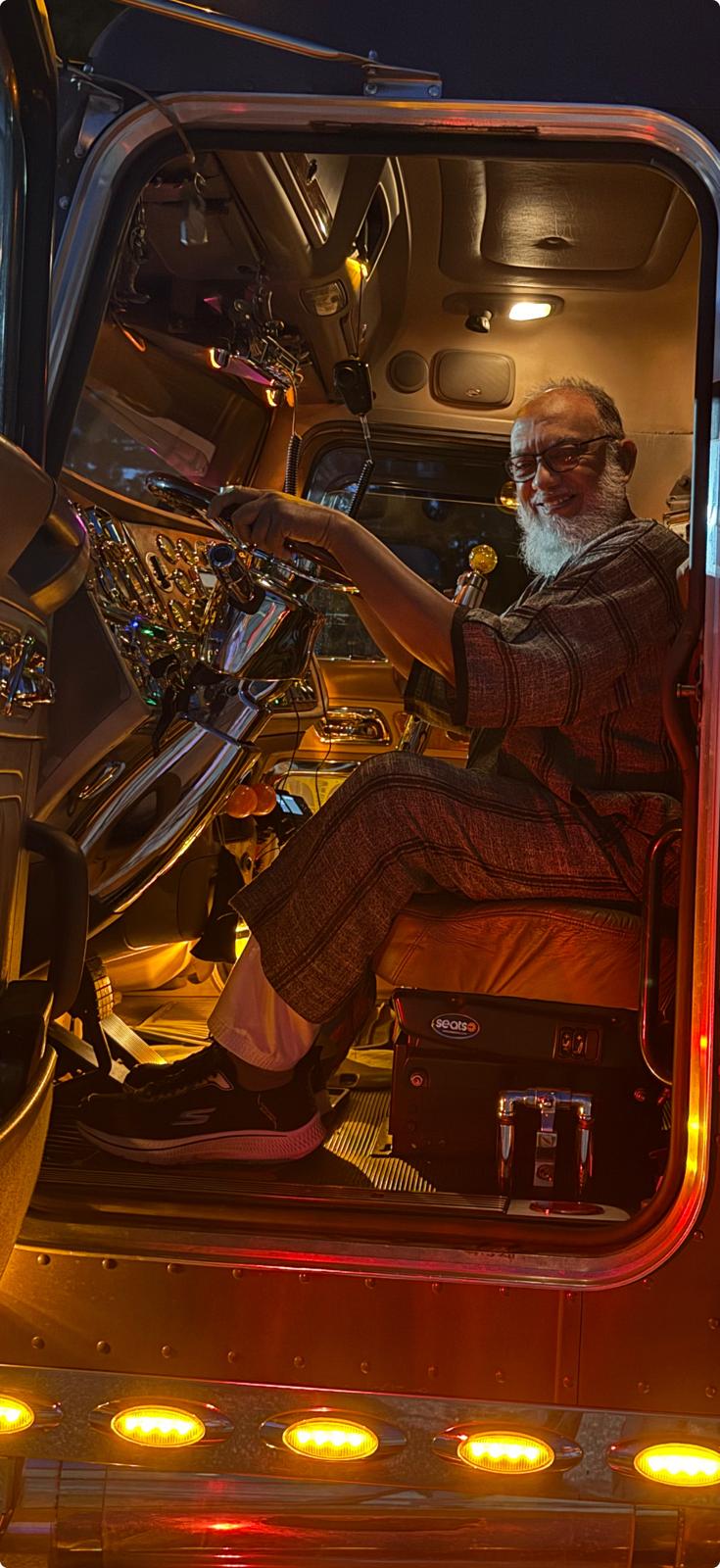
All that is necessary because the driver drives the truck coast to coast, 2900 (say 3000) miles or 5000 km. Twice the distance between Kashmir and Kanyakumari. Though by law he must rest, he eats, sleeps and lives in his truck. The cab is so complex because it makes it possible for the driver to drive that truck in the safest and easiest way. To see one of these monsters reversing between two vehicles and parking is to see magic in real life. The magic of machinery operated by an expert who does it day and night and nothing else. These drivers are superspecialists and on average, make about $90,000 per year.
Then came the AI revolution which among other things created self-driving trucks and cars. Now I want you to think carefully about impact. Not about mechanics. The impact of AI on the average person who will be affected by it. I want you to ask yourself a simple question. “Who does it benefit in the end?” Let us take the truck driver example. As I mentioned there are 3.5 million of them. Multiply by 5 for family and you have 17.5 million people, who need housing, schooling, eating and drinking, medical care, utility bills for lighting and heating, retirement plans and even some holiday travel. They can afford all these because even today, $90K is good money in the US. Then bang, comes the self-driving truck. So sexy, so neat, so efficient, so safe on the road because there is no driver to fall asleep. Key words, no driver. What is not mentioned is that it hugely enhances the profits for the truck company owners. What about the drivers, you ask? They glibly tell you, “O! No problem. They can be retrained.” What you should ask is, “Retrained as what? To do what kind of work which will give them $90K/year?” Because the truth is that if the new job doesn’t give them at least the same income, how does he pay his health insurance, mortgage on his house, school fee for his children and all the rest of it? Same question for every worker who will be replaced.
They tell you that the AI revolution is like the Industrial Revolution. They lie. The Industrial Revolution changed the way we worked and gave a person a different job. The challenge for the individual was the learning curve. Today the individual who loses his job will not need to worry about a learning curve because he is not being replaced. His job has been eliminated. Remember my question earlier? Something that all the proponents of AI will never mention. “Who is the ultimate beneficiary?” The answer is clear as daylight. The ultimate beneficiary is the billionaire who invested in creating AI.
The same is true in the field of education. Today a student who is literate and numerate and has an internet connection has free access to the knowledge bases of almost any major Western university. The primary free knowledge base from MIT is MIT OpenCourseWare which provides open-licensed digital access to teaching and learning materials for more than 2,500 graduate and postgraduate courses. This is a completely self-guided platform featuring syllabus notes, lecture notes, reading lists, assignments, exams, and select videos across every department with no registration required. I am giving you only one example from one of the premier American universities to illustrate. Today many other major US and European universities offer such facilities. What that means is that a student can study free of cost, at their pace, from their homes and earn degrees from the most prestigious universities in the world. That is how homeschooling has become so popular globally. Homeschooled children are studying at Harvard, Oxford and Cambridge, among other universities. The only thing that is holding homeschooling back is the fact that in most countries both parents work to maintain their lifestyle and so need somewhere to park their children. It has nothing to do with learning but with daycare. That is not very comforting for us teachers, is it? Because what that means in plain terms is, we are redundant in our present roles. The roles have gone or are on the way out and we are in the first line that AI will eliminate.
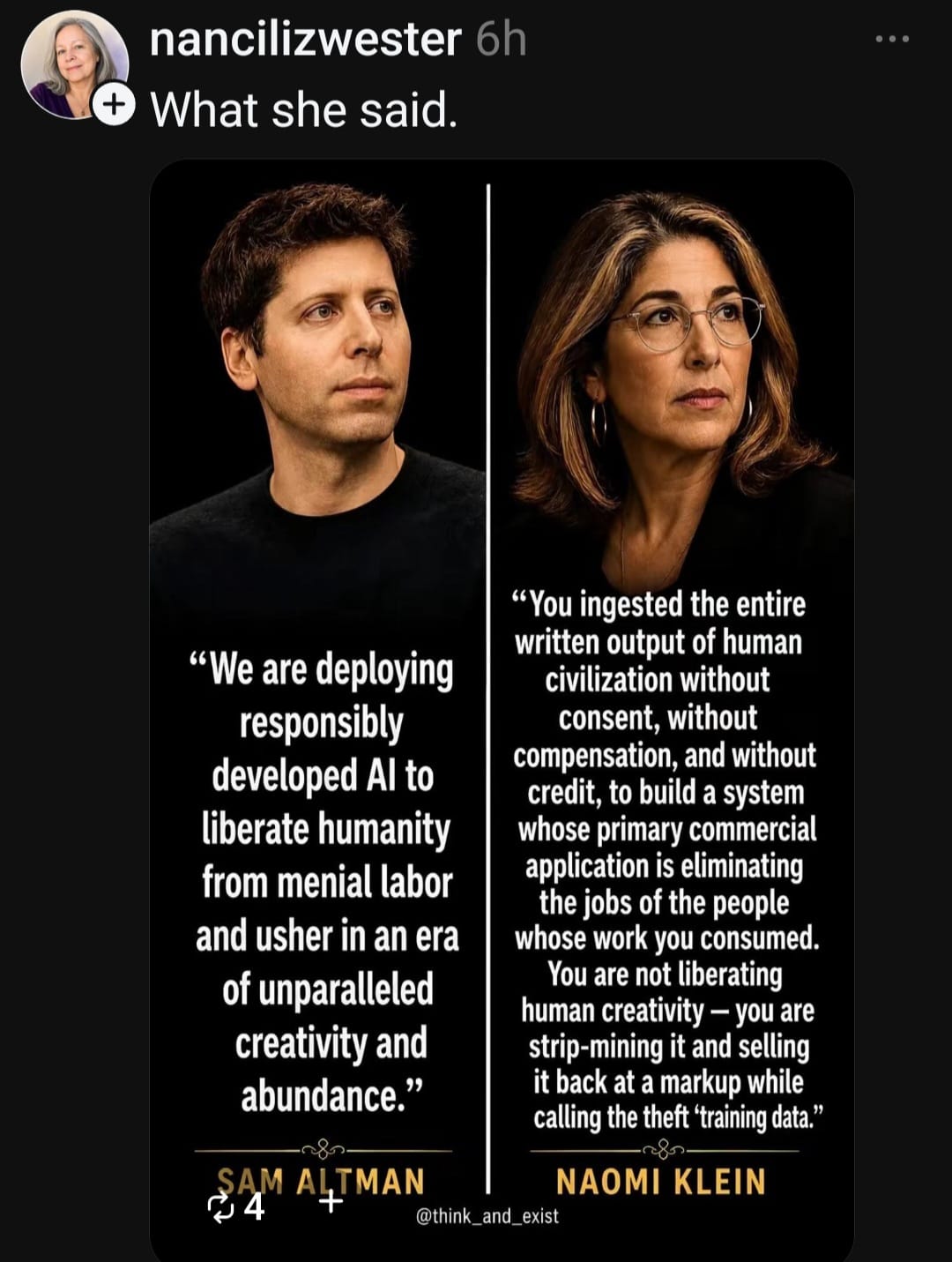
AI is all about dealing with data. In the words of Naomi Klein, social activist and Professor of Climate Justice and Co-director of the Centre for Climate Justice at the University of British Columbia, speaking to Sam Altman the CEO of OpenAI, “You ingested the entire written output of human civilization without consent, without compensation and without credit, to build a system, whose primary commercial application is to eliminate the jobs of the people whose output you consumed. You are not liberating human creativity – You are strip-mining it and selling it back at a markup while calling the theft, ‘Training Data’. All you need to do to see the truth of this statement is to watch a video of women tailors wired up with sensors and cameras, training AI agents (robots) who will take over their jobs. How ethical or moral is it to force poor people to teach robots and throw themselves out of work so that the owners of capital can enhance their margins is the question that nobody wants to ask. The truth is that those clothes and shoes made by AI agents will not be qualitatively any different from those made by humans with families to support and children to feed and educate. But the AI agents will make them faster and cheaper so that the profit margins for the business owners increase, while poor women starve. This is happening in industry and academia now.
Another related question that nobody is asking is, ‘Who will buy the products that AI agents will produce when you have kicked the majority of buyers out of jobs? Will this mean economic growth or a shrinking of the economy? What then will happen to all those people who will be on the streets watching self-driving cars and trucks sweeping past? What about people who will need medical aid but can’t pay for it? I will not list the many more questions and will let you make that list yourselves. I suggest that you then try to answer them or ask those who are trumpeting about the joys of AI to do so. The questions are real and so will the consequences be. The answer to this question according to Elon Musk is ‘UHI’. Universal High Income (UHI) is an economic concept popularized by himself, envisioning a future where advanced artificial intelligence and humanoid robotics create total material abundance, allowing society to provide every individual with a high standard of living rather than just a basic survival safety net. This concept is so ridiculous that it is not even funny. Simply ask, ‘When in the history of humankind have you seen billionaires dishing out large sums of cash to poor people?’ In this counter utopian world, we are told, robots will do all the work and people will simply get cash to spend and every facility will be free. I don’t think I want to waste your time by going further into this fantasy.
Finally, what will be the consequences of AI in our lives in so many other ways? When calculators came into our lives, we lost the ability to do sums in our heads. When smartphones came into our lives, we lost the ability to remember numbers. When ChatGPT came into our lives, we lost the ability to express our thoughts in writing and for many of us, even the ability to think. Research shows that when children are exposed to screens from an early age, which is the situation in most of our homes, it retards the development of the prefrontal cortex, located at the very front of the brain behind our forehead, and is the seat of intelligence and higher-level cognition. This is what Gemini has to say about the functions of the prefrontal cortex.
Executive Functions: Manages planning, decision-making, reasoning, and problem-solving.
Working Memory: Holds and manipulates short-term information to connect new thoughts and ideas.
Self-Control: Regulates impulses, suppresses socially unacceptable urges, and weighs future consequences.
Emotional and Social Control: Interprets social cues and links emotional responses with thought processes
Now imagine an entire generation which will be deficient in all these functions. We are already seeing signs of this all around us in society, but I will leave you to have fun imagining how life as a grandparent will be with grandchildren addicted to smartphones with deficient brains to take care of you. That is the real price of lazy parenting that we have become used to, and nobody wants to address. The price of convenience is disability. The only people who will benefit from a population that is not capable of analytical thought or even thought itself, addicted to TikTok, Instagram and Snapchat, graduates of WhatsApp University, with the attention spans of monkeys and goldfish, are those who want to manipulate and exploit them. People who will not question or oppose. People incapable of analytical thought or critical assessment. People who can’t visualize consequences or dream of the future. People who are lost in their devices and will simply do what they are told to do. That is modern slavery which needs no physical chains because the real chains are in the mind. To get all excited about AI and treat it simply like a tool that is sharper than others in the toolbox means that the individual doesn’t understand AI or the real purpose behind its aggressive implementation all over the world. Ask where the maximum deployment of AI is. In cancer research, poverty alleviation, even the Space Program? Or in surveillance and weapons? Then ask why? The future of the AI world as I fear is: Loss of jobs at the bottom of the pyramid leading to a shrinking economy and increased poverty. Critical drinking water shortages thanks to water guzzling data centers. Higher debt, hunger, and loss of healthcare. Rise in crime, social unrest and wars. When billionaires build bunkers, the writing is on the wall.
The Industrial Revolution changed the way work was done. AI eliminates the job itself. This is the harsh reality that nobody wants to talk about. Our jobs are no more. Unless we reinvent our roles to address and fulfill the need that AI cannot do. Every cloud has a silver lining. This is ours if we can do it right.
Before I go there, let me share with you the concept of ‘knowledge’. There are four different aspects to the way we assimilate experience. The first is experiential data. We collect it every waking moment, most of the time unconsciously. Everything contributes to it. Our speech, actions, interactions with our environment in every way, generates data. We can’t help this. We can’t stop this. It is like breathing. If we are alive, we are data collectors. When we organize this data in any way, it becomes information. Information is more focused and searchable and is the basis for the next step, knowledge. Knowledge is organized around a single or related topics and becomes the basis of output of various kinds. Almost all action, all production, all innovation are based on knowledge. But we are still not safe from AI here. We must go one step higher, where AI can never reach. And that is the stage of wisdom. Wisdom sits at the center of the web that connects multiple and diverse knowledge bases. It assimilates them, distills the lessons and extracts learning that enables the individual to see the whole picture and devise powerful interventions. This is the level that AI can never reach. This is the place of healing, counseling, mentoring, dreaming and making dreams come true. It is the place of learning to see with the eyes of the heart. It is the place of seeing ourselves in the mirror of the heart and recognizing the Hand of the Creator in His creation. Human actions are all replicable and can be done by machines, mostly more accurately and faster. But wisdom is about being human and is not replicable. Only humans are and can be wise.
In the words of my dear friend of more than 50 years, Dr. Mohan Alexander after reading this post: The tragedy of humankind is that its relentless pursuit of progress, power, and personal advantage so often comes at the expense of others. We seem to have mastered the art of advancing ourselves without giving sufficient thought to the cost others must bear. One can only pray and hope that a few among us will truly understand the meaning and importance of consideration, empathy, and compassion, and have the courage to act upon those values. Perhaps they will influence a few more, who, having seen the light, will in turn influence others. And perhaps, slowly, the circle will grow.
But is this anything more than idealism? I fear that, for the most part, it is. Noble in thought, admirable in principle, but painfully impractical in a world driven by greed, ambition, competition, and an insatiable hunger for more. The tragedy is that the very forces we celebrate as the engines of progress are often the ones that destroy our capacity for compassion.
So, where does that leave us?
Perhaps with the uncomfortable realization that while we may hope for a better world, we cannot realistically expect humanity to change its fundamental nature merely because technology has advanced. AI may be the instrument of a transformation beyond anything we have known, but the question of who benefits, who suffers, and who cares will remain as old as humanity itself. And therein lies the real challenge—not merely to teach, or to learn, or even to adapt to AI, but to preserve our humanity in a world that may increasingly have little economic use for it.
I hope I am wrong in my pessimism. But I fear that hope, without a corresponding change in human priorities, may remain just that: hope.
AI’s problem today is not technological but moral and ethical. That needs to be addressed urgently, and legislation enacted to control the development and deployment of AI so that the owners of capital don’t benefit at the expense of everyone else. Machines can’t do this. You can. Only you can. It needs humans with courage who care enough. For that there are three attitudes which are critical for us in this new world.
Courage: Courage is the first. Courage is the willingness to stand up against opposing danger or force. The greater the opposing force, greater the courage needed. Courage is physical but even more importantly it is moral. Moral courage comes before physical courage and is often its motive force. Moral courage is called upon far more often than physical courage in our lives because the pressure on us comes from those who have higher authority, directly or indirectly. They don’t necessarily threaten our life or safety, but they threaten our careers. Yet we must have the courage to stand up to their threats, open or implied.
But stand up on what basis? On the basis of truth. In the words of Martin Luther King Jr., “When the truth must be spoken, silence is culpable.”
Truth: Truth is the unshakable belief that Duty comes first and over and above anyone else. The duty of every citizen is to be responsible for their neighbors. For this, we are accountable and answerable because that is meaning of society. We are answerable to each other and to society at large. And though society may not have the power to demand this accountability in a formal manner, it does enforce it very powerfully by giving or withholding respect and moral authority. Moral authority is the reward for moral courage. Without moral authority you may get rank, but you will never have power. Rank is bestowed. Power is earned. The Establishment bestows rank. People give you power. Without power, the badge of rank is costume jewelry.
Compassion: The ability to see yourself in the suffering of others. In the words ascribed to Benjamin Disraeli, 1st Earl of Beaconsfield, who twice served as Prime Minister of the United Kingdom, “There but for the Grace of God, goes Disraeli.” He reportedly said that on looking at a homeless man in rags. It is not known what he did thereafter, but the statement shows that he saw himself, at least momentarily, in the other less fortunate man. Compassion is not only to see but to do something about that, to alleviate the suffering, lift the oppression and deliver the justice being denied. Compassion, above anything else, differentiates us as humans in the best possible terms. Compassion means that we stand against oppression even when it doesn’t affect us personally. Compassion means that we go out of our way, take the pain and the trouble and if necessary, pay the price to fight for the rights of others. Compassion is a fundamental value, a core strength and a key resource, without which we simply can’t function effectively and honorably. Compassion is the result of courage and commitment to the truth. Compassion wins hearts, inspires cooperation, builds a reputation, enhances influence and strengthens civil society. Compassion defines, ennobles and dignifies us and is the highest indicator of humanity.
This is the value of these three, interlinked attitudes: courage based on truth, tempered with compassion. Truth gives courage its backbone and compassion ensures that it is applied in a way that is caring, respectful and kind.
Finally, I must reiterate that attitudes can’t be legislated. They must be inculcated. We can’t simply order people, “You must be courageous. You must be truthful. You must be compassionate.” We must show them how, by demonstrating courage, truthfulness and compassion ourselves in our everyday actions. We must remember that people listen with their eyes. They don’t care what we say, until they see what we do. Teachers not only have a role in the AI World but a role that is far more important, fundamental, and valuable than it has ever been, provided we are willing to learn. The challenge is enormous, much of it in the fog of the unknown future and not clearly visible yet. But I have no doubt that if we are open to learning, willing to collaborate, respectful of each other and genuinely caring, we will overcome the challenge and leave behind a legacy that we can be proud of and will be remembered for.
I want to leave you with the gift of my motto. I will not allow what is not in my control to prevent me from doing what is in my control.
Comments (0)
Please log in or sign up to leave a comment
Loading comments...