It was 1970 and I was fifteen. I was a voracious reader, introverted, thoughtful, sometimes short of words, self-conscious with peers. I loved nature, the outdoors, animals and birds. I loved riding horses and trained dogs. When thoughts and feelings and what I didn’t understand, which today we know as hormones, became too much to deal with, I went for a walk. We lived in times before therapists and counselors. Where parents took parenting seriously which meant that they allowed children to grow up without hovering over them or making choices for them. They didn’t sign them up for tennis, music, martial arts, or any other classes. They left them alone to choose what they wanted to do, waiting until the child pestered them to be allowed to do it, and then agreed, apparently reluctantly. That way, the child had something to prove and didn’t need to be pushed to go to the class. We were the original ‘Feral’ kids. We climbed trees, rode the one kind of bicycle that there was and learnt to repair it. We fell out of both and wore our wounds and plaster of Paris casts with pride. Our friends signed their names on them. Some did that with artwork. Today with trees and bicycles as transport, casts have also disappeared. When was the last time you saw a boy with a cast? We took responsibility for ourselves, which was expected of us. No fuss. No parents coming to fight our fights.
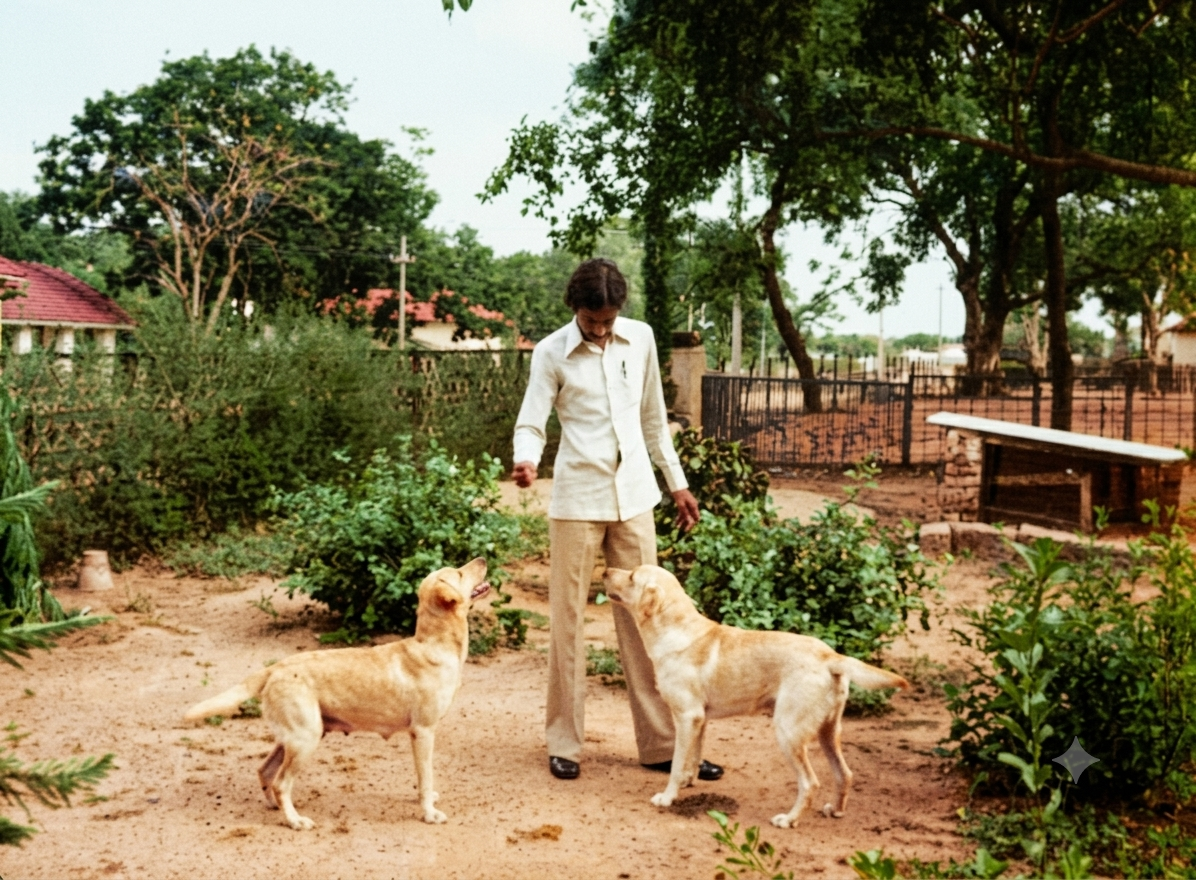
We lived in Czech Colony, Sanatnagar. It was called Czech Colony because it had originally been built for Czechoslovakian engineers who came to work at the Bren gun factory in 1946. 52 bungalows were constructed over 50 acres to house the European engineers. The houses were 2- and 4-bedroom units, with a bathroom between two bedrooms. A large central hall and verandas on either end. The kitchen was tagged onto one end of the back veranda. The house had a Mangalore tile roof without a ceiling, so you could see the rafters. It made a lovely pattern for you to gaze at as you lay in bed. Given the construction, the houses were home to sparrows, geckos and the insect of the week. I felt the breeze, smelt the rain, and fell asleep to the sound of the flock of Night herons, arguing about seating in the old Peepal tree just outside my room.
As I left my house for my walk, with my yellow Labrador Retriever, Ben, running ahead, I would go past St. Theresa’s hospital in Erragadda. Ben was trained to come to heel on command and so though I carried his leash, I never put it on. He loved to run around checking out new scents which to his highly sensitive nose told stories which I would never know.
Then came the Erragadda Pagalkhana, which literally means Madhouse. It was a hospital for mentally ill patients. You could see them holding the bars of their windows which resembled prison cells, staring at the world outside, muttering to themselves. People would go there to look at them much as you would go to a zoo and their antics and sounds were a source of merriment for them. Some people would try to provoke these poor people, and their enraged screaming would draw peals of laughter. Quite an awful situation if you ask me, and even if you don’t.
Past Erragadda was the tomb of Nawab Fakhrul Mulk and his wife. It is a granite mausoleum built in 1902 and perhaps the last example of Modern Qutub Shahi style. His palace (Dewdi) where he lived was next to the tomb and is now the Institute for Tuberculosis or TB Hospital. His other palace is at the other end of what used to be his garden, on top of the hill, called Erram Manzil. Past the tomb is Sanjeeva Reddy Nagar, which was still being laid out in 1970. The first row of houses in it were six or eight pink colored houses which had been allotted to IAS officers. These faced the road that was the continuation of the Bombay Highway that entered Hyderabad city from Sanatnagar. On the other side of the road was a wide open plain, that ended at the foot of Banjara Hills about two miles away. This is where I would leave the road and strike out across the plain, heading for Banjara Hills.
The ground was covered with tough grass that almost instantly became green with the first monsoon showers. It was peppered with Lantana (Lantana camara), Custard Apple (Seetaphal – Annona squamosa), and Ber (Ziziphus mauritiana). There were Neem (Azadirachta indica) trees and the occasional Gulmohar (Delonix regia) with its flamboyant display of orange and red flowers in summer. Sometimes there would be a shepherd with his flock of goats and sheep who would wave to the lone boy walking with is dog. There were also many Toddy palms (Borassus flabellifer) the source of both toddy, Neera (unfermented sap), and Munjal, its immature seeds which are considered a delicacy. Sometimes I would see the toddy tappers climbing the tree to cut the end of the inflorescence (flower cluster) and hang a pot from it to catch the sap that drips out. The sap ferments and turns alcoholic, called toddy (arrack or sendhi). The sap is also boiled down to make palm sugar. If the pot is coated inside with lime juice, it prevents fermentation and the resultant sap is called Neera and is not alcoholic. It’s very interesting to see how the palm tappers climb the straight, pole-like trunk of the palm. They carry a ring made of braided grass, which they twist and put around both their ankles holding them almost together. They then hold the palm trunk with their hands with fingers linked together and hop onto it with their feet in the grass braid anklets and climb up dragging their feet up and straightening their backs and thighs with their linked hands reaching up for a higher grip. From a distance it was like seeing a caterpillar climb a twig. Their tools, little black earthen pots, tapping knife and a chopper, hung from their belt. The chopper was to trim the palm fronds and clean up the crown as necessary.
As I walked along, I would hear the shepherd calling his sheep. He would stand on one leg, his other foot on his knee, holding his staff with both hands and leaning on it. Looked like quite a precarious position, if you ask me, but that is how they stand. In the sky I would hear the call of the Tawny Eagle (Aquila rapax), soaring on the thermals that the rocks of Banjara Hills were very good at producing. I would see the Common Kestrel (Falco tinnunculus) hovering still in midair as she scanned the ground for prey and the Shikra (Accipiter badius) announcing his presence. As the evening progressed, Teetar (Grey Francolin or Grey Partridge) would start calling, the males announcing their ownership of territory and challenging any potential rivals. Teetar are very territorial and this was used by the Pardhi community, a traditional nomadic hunter gatherer tribe, to trap them. The hunter would bring his pet male Teetar in a cage and set it out in an open place and surround it with a fine net. He would sprinkle sand, grass bits and leaves on the net and hide behind a rock or bush. The Teetar would immediately start calling and sure enough it would be answered and in a short time other males and some curious females would emerge and surround the cage. The hunter would then draw in his net, and he would have his haul for the day. Pardhi hunters and trappers would bring Teetar, hares, Batair (quails) and wild honey to the weekly village market and sell them for what they needed.
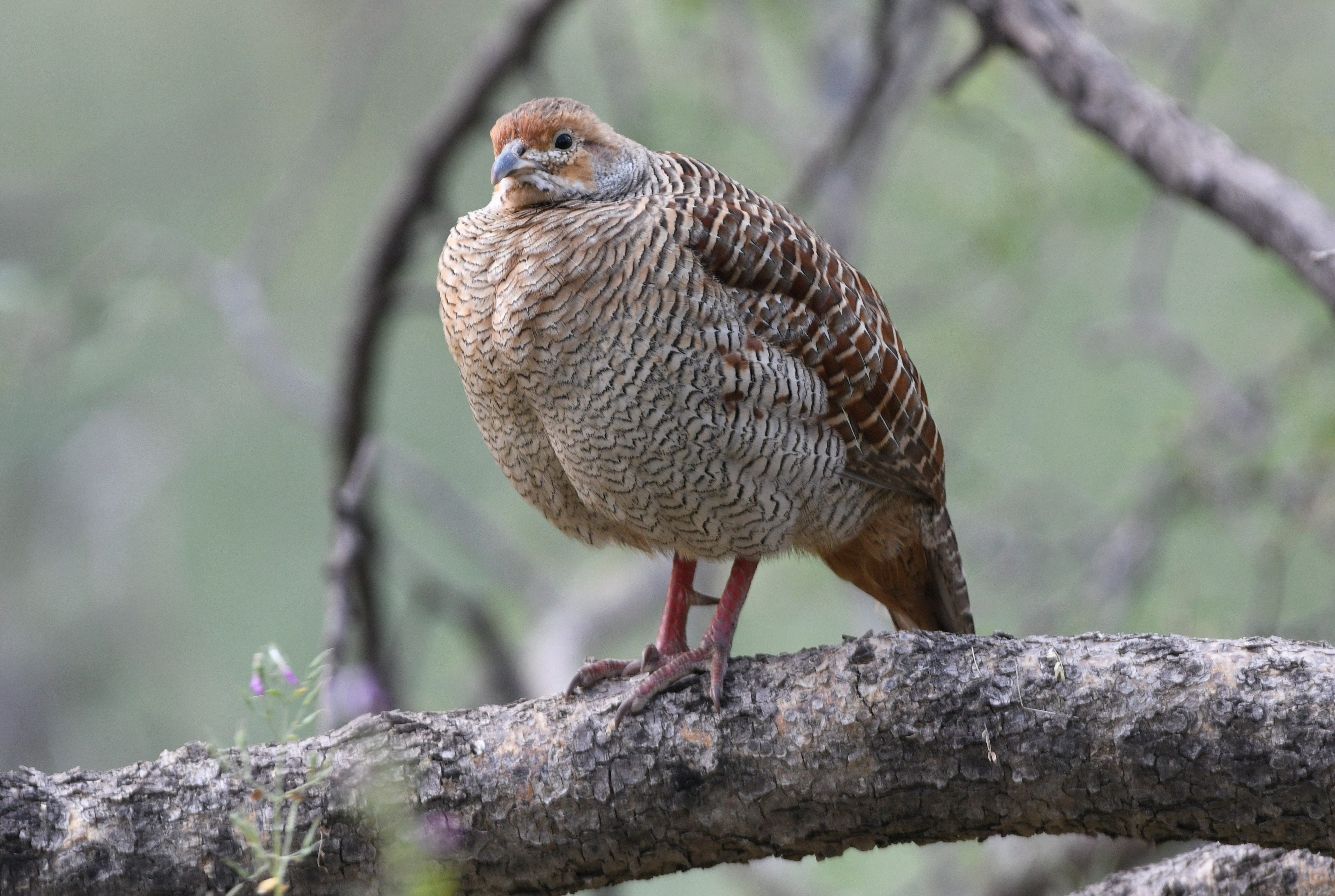
There is something very lovely about the Teetar call which draws you to the Deccan. As I got closer to the foothills, I would hear the mournful mewing call of the peacock, perhaps one of the loudest of all bird calls. I must tell you that birds have calls to convey different messages. Alarm calls to warn about predators. Some birds like peafowl call as they fly and from the call you can tell that the bird took flight. Then there are calls to announce daybreak and sunset. Especially in the summer I would hear the incessant call of the Brain-fever bird (Common hawk-cuckoo). There were Spotted Doves, Laughing Doves, and the Eurasian Collared Doves, Hoopoes, Mynahs, lots of Sparrows, Red-vented Bulbuls, Green Bee-eaters, Rose-ringed Parakeets, Sunbirds flitting from flower to flower in search of nectar. What I hardly saw was the Blue Rock Pigeon. Today you only see Rock Pigeons and almost none of the birds that I have named.
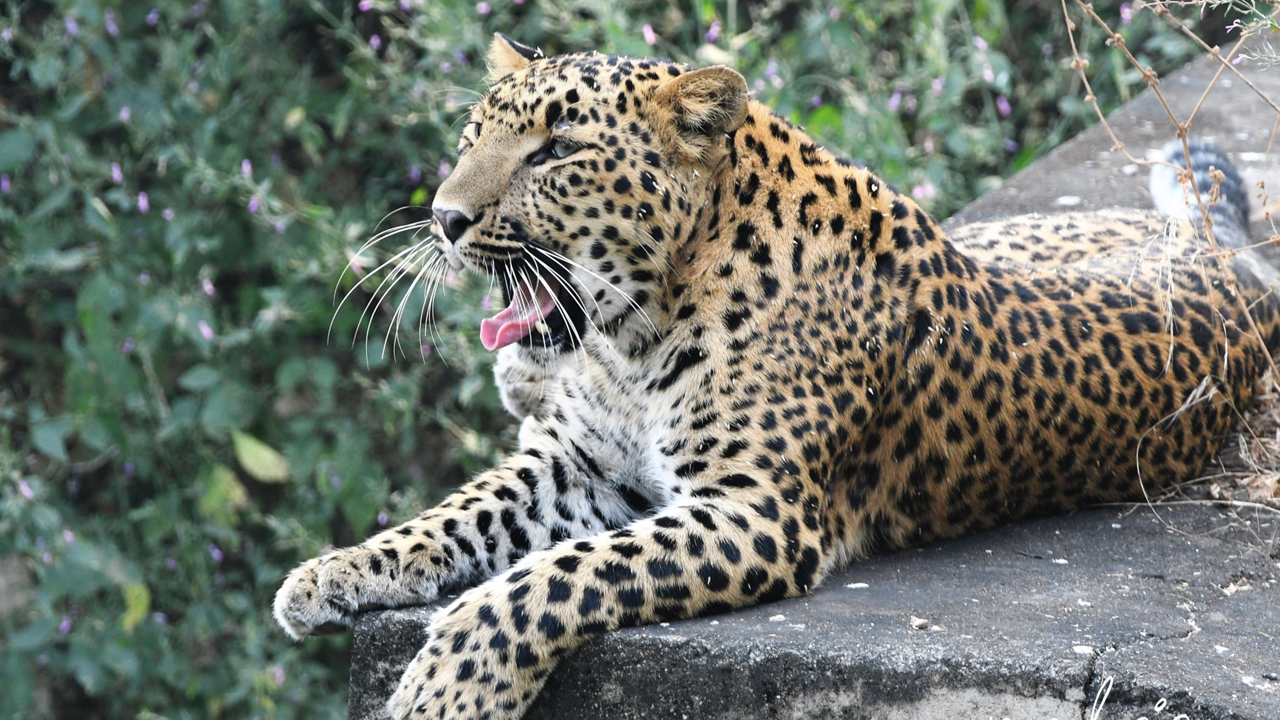
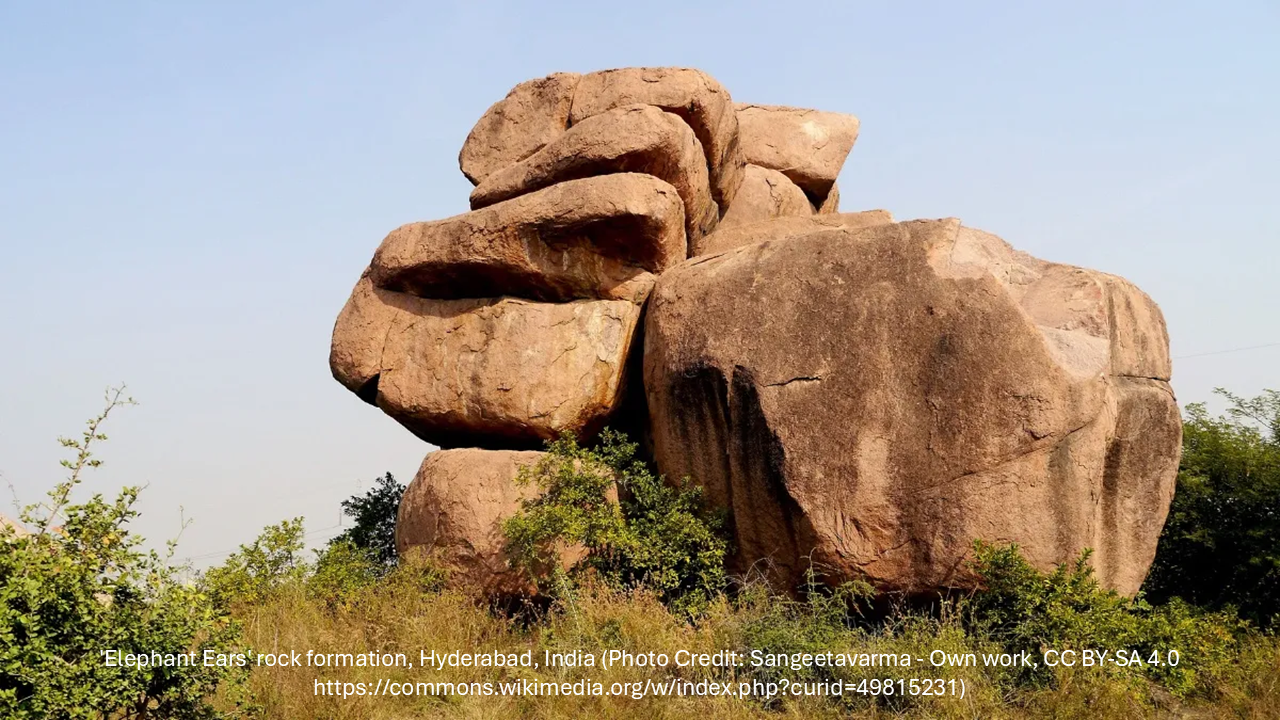
By now I am at the beginning of the climb up to Banjara Hills, dominated by its unique rocks. These were huge granite boulders in impossible shapes, set one upon the other in impossible positions. Many times, a small boulder supporting another ten times its size, in perfect stability. These formations created small and large caves, inhabited by Leopards and Sloth bears. There were Jungle cats, Indian civets, Jackals, and lots of Black-naped hares. For the record there were also a lot of snakes. I would routinely see Rat snakes and Cobras. On one or two occasions, I saw a Rock Python. And there were Kraits and Vipers. And where there are snakes there are Mongoose and so there were. There were also many Wild boar and Porcupines. It was a lively place with lots of tenants.
In some places there were small depressions in the rocks which would hold some rainwater for a while. Later dust would collect in it followed by grass seed and the seeds of different plants, which would germinate and create a small garden on the rock. In some places a Banyan (Ficus benghalensis) or Peepul (Ficus Religiosa) would take root and cling to the rock stubbornly with tenacity. Eventually in some places the roots of the tree would split the rock. Both these species, being figs, attract a lot of birds and are alive with birdsong. However, they are not safe to sit under in the evening when the birds ‘come home’, unless you enjoy being peppered with guano.
The grey and pink granite boulders scattered across Banjara Hills were between 2.5 to 3.5 billion years old. They are among the oldest rocks on the planet, predating the Himalayas which are only about 50 million years old. They began as molten magma deep within the Earth's crust that cooled and solidified into massive granite sheets. Over millions of years, tectonic shifts pushed the rock upwards. Constant exposure to wind, rain, and intense heat caused it to crack in a process known as "spheroidal weathering." Soft outer layers eroded away, leaving behind hard, rounded inner cores. As gravity and erosion continued to shift the landscape, these massive boulders settled, leaving the spectacular, gravity-defying, and balanced formations that were so common in those days and which I had the good fortune to see and know well.
As I continue my walk, I reach the wall of Chiran Palace. This was a ten-foot masonry wall surrounding the entire property with two (to the best of my knowledge) huge wooden gates. One where today we have the main entrance to KBR Park and one on the opposite side, opening onto the Jubilee Hills road. I take a right at the wall and walk along it until it curves off to my left and I come to the boulder which is like a friend to me. I climb up its side to its flat top. Sometimes, I would take Ben with me to the top. At other times, especially if I had reached the rock early, I would climb up and let him run around making olfactory discoveries around the base of the rock. As I mentioned to you, there used to be leopards in Banjara Hills. And so, if it was getting late, I would make sure that Ben was with me on top and not running around below ready to become leopard dinner.
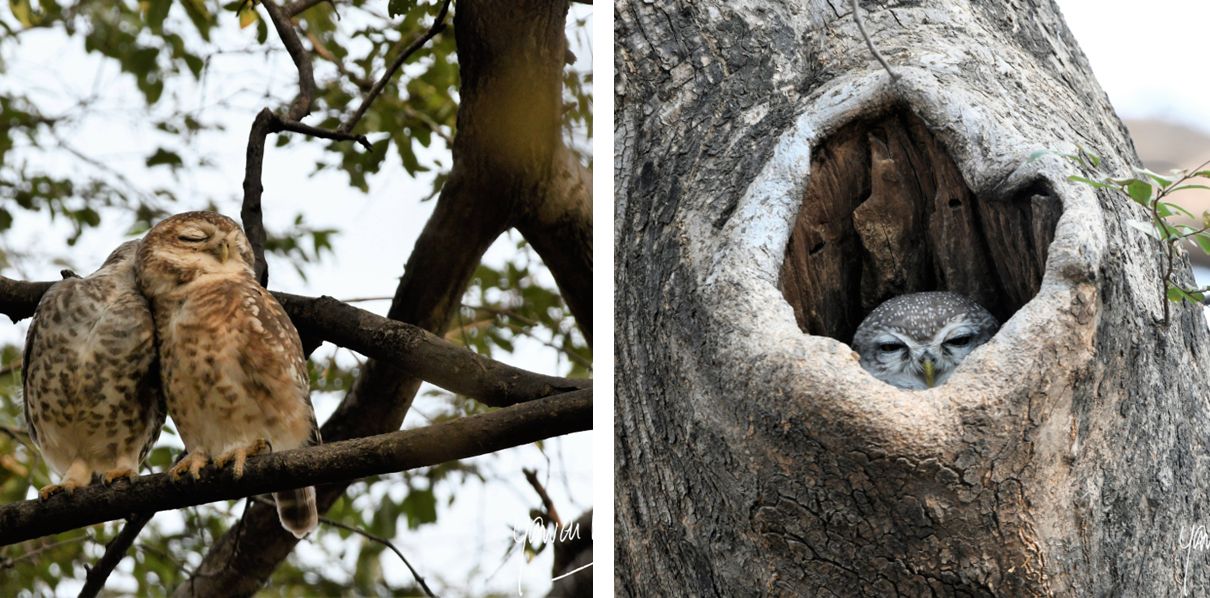
I loved the silence, the cool breeze a counter to the warm rock. Peafowl announcing the coming night. The Churrr of Nightjars awakening and preparing to go to their ambush spots from which they will arise like avenging angels and snap up any insect that dares to fly past. I can hear the hoot of owls. A pair of Spotted Owlets emerge from the tree hollow they spent the day snoozing in and sit snug against each other on the branch above. They rub beaks, groom each other and display affection that is such a joy to watch. They talk to each other, and I imagine that they are telling each other where they plan to hunt that night. And as it gets dark, they fly off, one after another.
You must sit on a rock that has baked in the sun all day to feel its warmth, even heat, in the evening. These rocks had been doing that for 3.5 billion years. The view from the top of the rock was spectacular. Behind me I could see Chiran Palace, a large modern looking mansion really and not a ‘palace’ in terms of its architecture. Before me, way in the distance, at the top of Golconda Fort, was Bala Hisar.
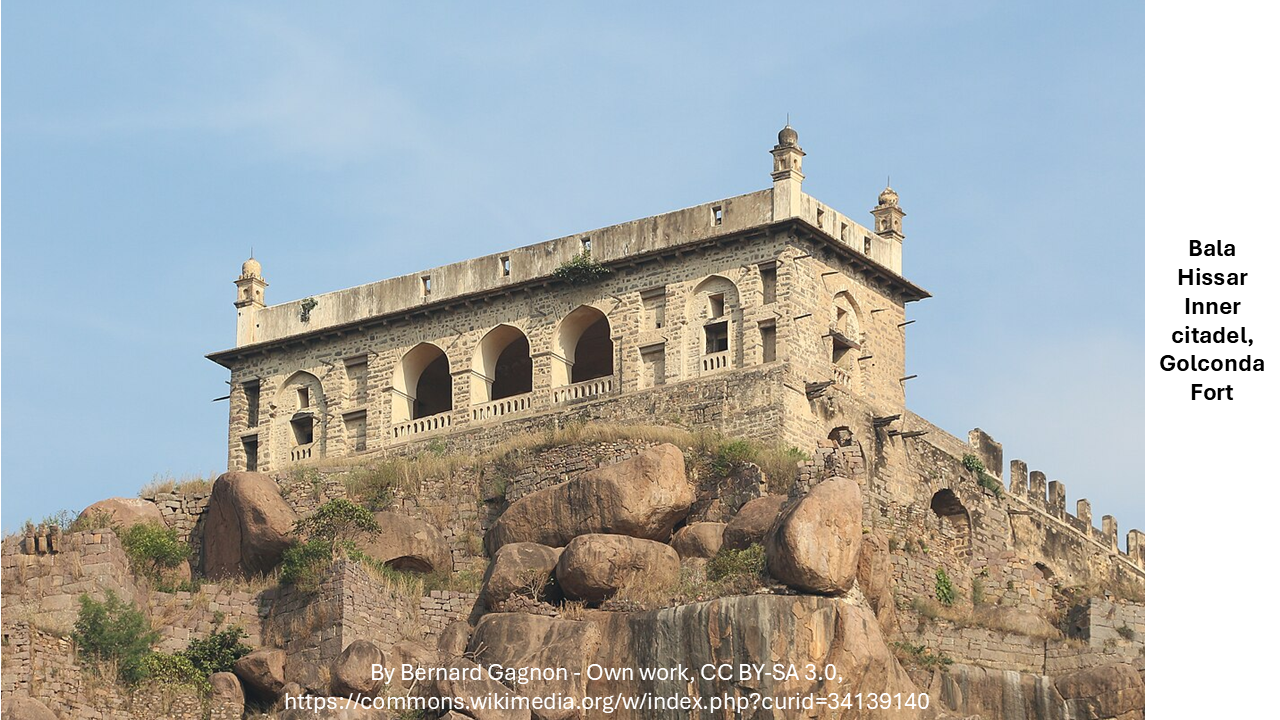
I say to my rock, “Tell me what did you see in the time you have been here?” The rock said, “I saw a king, reclining on his throne in Bala Hisar, listening to his singing girls. I saw that fort when it was built of mud on a granite hill by the Kakatiyas. Then there was a war and it was taken over by the Bahmani Sultanate who strengthened it by adding formidable stone walls and bastions. Then came the Qutub Shahis and Sultan Quli Qutub Shah and his descendants converted it into a massive 5 – kilometer granite fortress which was considered impregnable. Then came Prince Aurangzeb who besieged Golconda. I saw the most famous dowager queen of the Qutb Shahi dynasty Hayat Bakshi Begum (1591–1667), affectionately known as "Ma Saheba", who was uniquely connected to the dynasty as the daughter of Muhammad Quli Qutb Shah (the founder of Hyderabad), the wife of Sultan Muhammad Qutb Shah, and the mother of Abdullah Qutb Shah, who negotiated a treaty that gave Golconda peace for thirty years. A mere blink of an eye for me, but for you humans, that is a generation. Aurangzeb returned because the temptation to conquer the kingdom which had the only diamond mines on earth from which had come the glorious Kohinoor, which graced his father’s throne was too much. He returned and conquered Golconda and the kingdom ceased to be Golconda and eventually became the State of Hyderabad, ruled by Nizam ul Mulk, Asaf Jah I. The different kings in that dynasty came and went, until the last of them in whose time, that dynasty also ended. Now, I have you, a kid with nothing better to do than talk to a rock, sitting on me asking me what I have seen. Let me tell you that a day will come when you too will be gone but I will still be here.”
The rock was correct in all respects except the last.
Today, the rock has gone but I am still here.
Comments (0)
Please log in or sign up to leave a comment
Loading comments...